Writing
Black holes and their immense beauty
The darkest objects in the universe are also the brightest
The big and the small
Imagine standing on a beach on the west coast of Spain, looking out over the Atlantic. The ocean stretches out as far as the eye can see, well past the horizon. Yet the patch of water you can see is a tiny fraction of the Earth’s surface, about one hundred-thousandth of a percent of it. The Earth is enormous.
Now imagine the seemingly impossible: the entire Earth, the enormous body humanity has lived on for its whole existence, shrunk to the size of a shirt button, about eight millimetres across. The Earth’s mass packed into that space would be so dense that the electrons, protons and neutrons that make it up would be crushed together, and then crushed further. So much mass in so little space would bend the path of light, the fastest thing there is, so severely that light would become trapped. Where the Earth once was there would be a black sphere the size of a peanut. Black, because no light can bounce off it and reach your eyes. The universe’s perfect shadow.
This black sphere, the remnant of the Earth’s catastrophic gravitational collapse, is a black hole. Black holes have no surface in the way planets and stars do, because anything that comes close enough is pulled in like water down a drain. Instead they have an event horizon. The horizon is a boundary in space and time, like a door between two rooms. Step through it and, like a cosmic prison, you can never leave. Not even light can escape the gravity inside.
To the surprise of many non-physicists, black holes are everywhere. They are a normal part of the life cycle of massive stars, and they mark its end. When a massive star burns through its fuel, like a firework fizzling out, there is no longer any energy to resist the pull of gravity. Gravity turns the star against itself, compressing it to unimaginable densities. Eventually, just like the shrunken Earth, it becomes a black hole.
You can see why black holes are so common. The universe is old and full of stars. Countless stars have already lived and died, and many were massive enough to leave behind black holes. Astronomers believe that essentially every galaxy we see harbours a supermassive black hole at its centre, shaping the motion of the stars around it.
The mysterious and the unknown
The event horizon is not the only strange thing about a black hole. Deep inside, at its very centre, lies an even greater mystery.
As you fall past the event horizon, gravity only grows stronger. Remember that not even light can escape once it is inside: gravity has become so strong that it overwhelms the speed of light, like a sprinter on a treadmill set just a little too fast. Go further in and it grows stronger still.
There is one and only one possible destination: the centre. Gravity there is so unimaginably strong that the mathematics of general relativity itself breaks down. This place of incalculable gravity has a special name, the singularity.
Outside the black hole, the forward march of time is an incontestable fact. Inside the horizon, in the domain ruled by the singularity, the forward march of space towards the singularity becomes that absolute truth. Space and time quite literally swap roles. The watch on the wrist of an astronaut falling in would be better replaced by a GPS.
Physicists have no idea what truly happens at the singularity, because our mathematics fails there. And we could never probe it directly, because singularities are always hidden behind event horizons, and no light from them can ever reach our detectors. This cloaking of the singularity is called cosmic censorship. It was first proposed by Roger Penrose, but it has never been mathematically proven.
The singularity remains a mystery, and anyone who ventured in to see it could never return to tell us. There have been many attempts to model what happens there, but it will be a very long time, if ever, before we truly know what lies at a black hole’s heart.
Outshining the universe
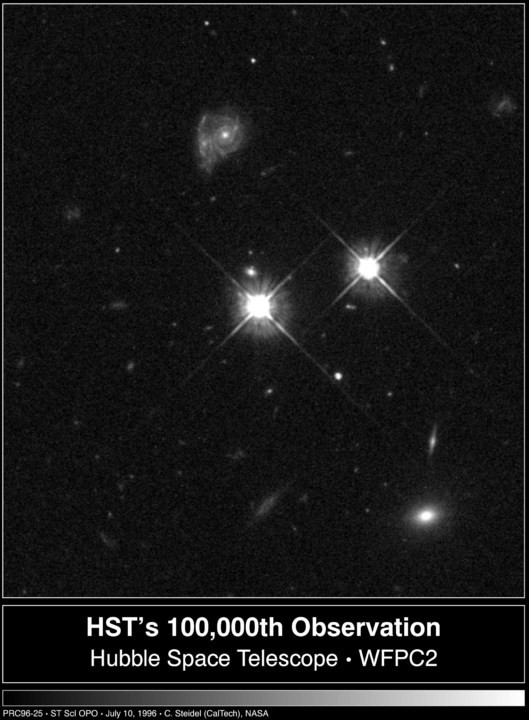
The inside of a black hole is not its only interesting place. A black hole also has a unique effect on its surroundings. Gas and dust can orbit it, sometimes at incredible speeds, and the friction and viscosity of that fast-moving material heat it until it glows ferociously bright. A single black hole can light up its surroundings so intensely that it outshines entire galaxies. The darkest object in the universe becomes the brightest.
The image alongside is my favourite astronomical image ever taken. It shows the raw power of a black hole in action. The bright point at the centre is a quasar: the nucleus of a distant galaxy whose supermassive black hole is heating the matter orbiting it until it shines brilliantly. The second bright point to the right is an ordinary star in the foreground.
Notice how they look almost equally bright. Yet the quasar is several billion light years further away than the star. Even at that distance it nearly outshines everything around it, and it takes a star several billion light years closer to match it. That is unfathomable power.
In my eyes, black holes remain among the most beautiful things in the universe. They shine as brightly as they are mysterious. They break the very mathematics we use to describe gravity, despite being purely gravitational objects. Once every star in the universe has burned out, black holes will be all that remains. And eventually, through subtle physical processes, even they will fade away.
Header image: EHT Collaboration (CC BY 4.0)