Writing
Warp drives: the limitless future
How humanity could become the architect of space and time
Our nearest neighbour
The best way to grasp the universe’s unimaginable size is a small thought experiment. Imagine you are standing in downtown London holding a sewing pin, and imagine the entire universe shrunk so that the Earth is the size of the pin’s head, about two millimetres across. Now suppose you get the urge to visit the Sun’s nearest stellar neighbour, the Alpha Centauri system.
In this miniaturised universe, that trip is a walk from London to Chicago. If the Earth were the size of a pinhead, Alpha Centauri would be over 6,000 kilometres away.
And that is not the worst of it. Humanity has built rockets and probes, and we have landed on other worlds. The fastest object we have ever made, the Parker Solar Probe, tears through space at more than 600,000 kilometres per hour. In the miniaturised universe that is a crawl of two hundredths of a millimetre per second. Imagine walking from Vancouver to the border of Colombia at that pace.
It would take over seven centuries. That is how long the fastest thing we have ever built would need to reach the nearest star.
And that is only our nearest neighbour. Forget the rest of the galaxy, let alone the rest of the universe. Rocket technology will not cut it for interstellar travel. We need something much, much faster.
What are our options?
Humanity could send generation ships: enormous vessels whose crew’s distant descendants are the ones who finally arrive. But this comes with serious problems, among them
- keeping the ship running for several centuries with no outside help,
- carrying enough fuel for the initial acceleration, the final deceleration and any course corrections along the way,
- and sustaining a self-sufficient human habitat for the entire journey.
We could also launch seed missions. Instead of sending living people, we send frozen embryos together with the nutrients and machinery needed to raise them on arrival. This is even less appealing than the generation ship, because none of us would actually be doing the travelling (though some might see that as a plus). And it has its own failure modes: machinery breaking down, embryos and supplies degrading, and no crew on board to fix anything.
A third option is a swarm of robotic explorers that report their findings back to us. This is the least satisfying of all, since no human would ever actually see another star up close.
Enter the warp drive
How, then, do we beat distance and time? The obvious answer is to go faster. But nature has a speed limit, the speed of light, and it is a built-in property of spacetime. Nothing can move through spacetime faster than light.
But what if, instead of moving through spacetime, we moved spacetime itself?
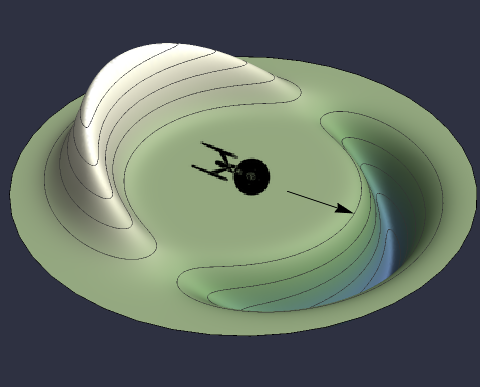
This is a deep and complicated question, but one with profound consequences. In 1994 Miguel Alcubierre wrote down a remarkably simple solution of Einstein’s equations, the equations that describe what we call gravity. It describes a small region of space that can move at any conceivable speed, including, as seen by observers outside, faster than light.
The intuition is captured by a single quantity called the expansion. A ship generates a matter field around itself so that spacetime takes the shape Alcubierre described. Behind the ship, space is expanding. In front of it, space is contracting. These two effects combine so that the bubble of spacetime containing the ship moves forward, dragging the ship along with it. Because it is spacetime itself that is moving, the ship can be carried at any speed.
Alcubierre’s solution introduced a genuinely new idea: use spacetime itself to push us across the universe. It also represents a new way of thinking about gravity that goes by the name metric engineering. We have long understood that matter tells spacetime how to curve, and spacetime tells matter how to move. Metric engineering turns this around. Instead of placing matter in spacetime and asking what shape it takes, we choose the shape we want and use Einstein’s equations to work out what matter would produce it. Humans quite literally become the architects of spacetime.
There is, of course, a catch. Feed the Alcubierre spacetime into Einstein’s equations and they tell you the required matter must have negative energy. Worse, it needs more negative energy than there is positive energy in the entire observable universe. This is a disaster for everyday physics. The famous $E = mc^2$ tells us that every particle carries an intrinsic energy, and that energy is never negative. So a solution that demands negative energy simply is not physical. (A caveat: quantum field theory does allow, and even predicts, small amounts of negative energy. But those amounts are either minuscule compared with what is needed to bend spacetime, or hopelessly beyond our reach.)
What can we do?
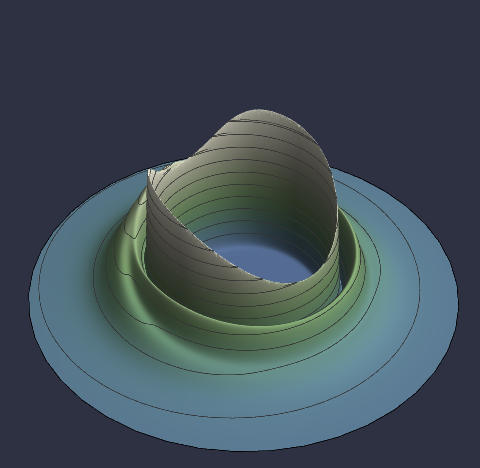
Many people have tried either to get around the negative energy requirement or at least to soften it. Some changed the shape of the warp bubble; some appealed to geometric quantities other than the expansion. A former colleague of mine even claimed to have found a positive-energy solution using a special geometric configuration, though that claim has since been called into question. So far nobody has fully solved the negative energy problem.
How, then, could we write down a solution of Einstein’s equations that describes a physically meaningful warp drive? We need to go beyond Alcubierre’s simple example. This is no easy task and involves formidable calculations, but hidden inside a natural generalisation of Alcubierre’s solution is a curiously simple geometric structure. I found this structure during my master’s thesis and published it in Classical and Quantum Gravity. It is not a complete answer to the negative energy problem, but it is a real step forward in understanding what warp drives are, and it offers a shimmer of hope against the otherwise bleak prospect of humanity’s isolation.
Research on warp drives continues today, although on a far smaller scale than the big collaborations in physics. Despite being three decades old, the field is still in its infancy. There is a great deal left to learn about how humans might one day become the architects of space and time, and it is a question I am still working on.
Header image: stock photograph